In 2026, most people don’t fail at digital marketing because they lack information. They fail because they choose the wrong way to learn it. The internet is overflowing with courses, tutorials, AI tools, and “experts.” Yet career switchers remain stuck, business owners burn ad budgets, and students collect certificates that don’t convert into jobs.
Digital marketing is no longer a “nice-to-have” skill. It’s a core business function and choosing the wrong learning path today can cost you years, not months.
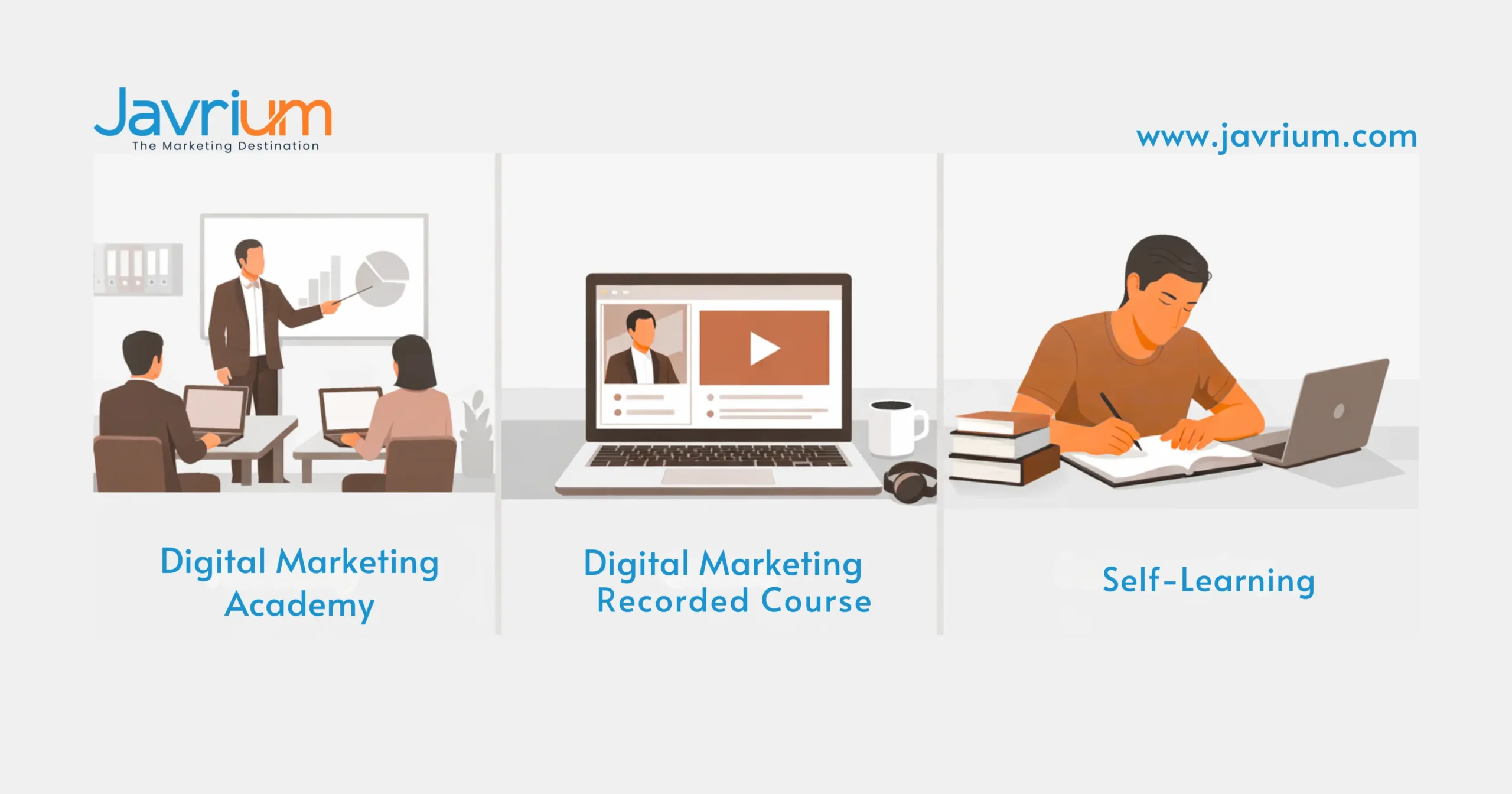
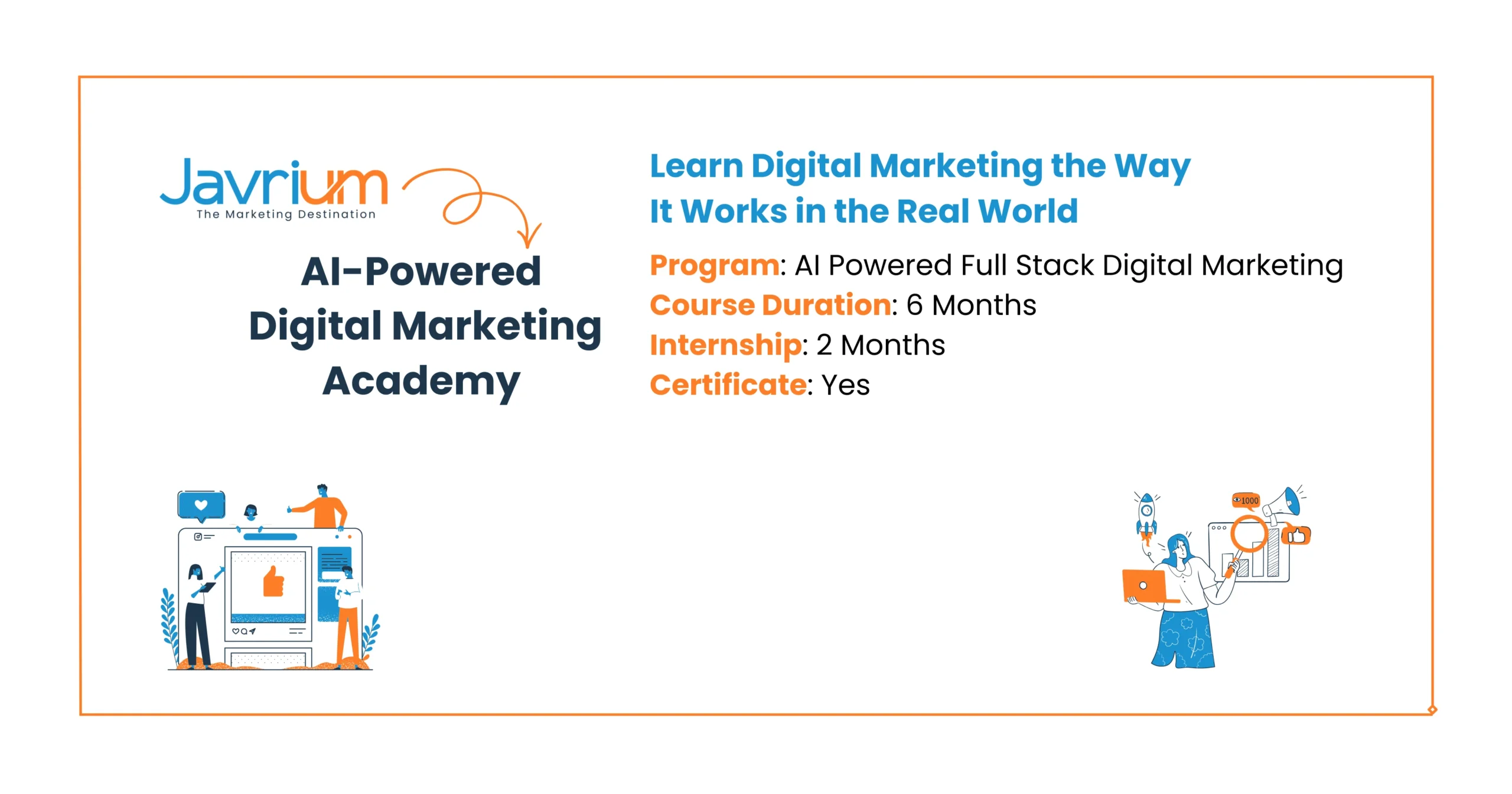
An Academy is a deep-immersion ecosystem. It’s not just “classes”, it’s a simulation of a marketing agency. It includes live mentorship, real-world client projects, and a heavy focus on the “Human+AI” hybrid skill set. Think of it as a professional finishing school.
A structured, mentor-led ecosystem that includes:
A Course is a structured, often self-paced or semi-live program focused on specific outcomes (e.g., “Master Meta Ads 2026”). It is modular and designed to get you from point A to point B efficiently, but usually lacks the deep networking and multi-layered feedback of an academy.
A pre-recorded or semi-live program, usually focused on:
Great for knowledge. Weak for execution.
The “DIY” approach. This involves stitching together knowledge from YouTube, newsletters, documentation (like Google’s Search Central), and free platforms like HubSpot Academy or LinkedIn Learning. It requires 10/10 discipline and a “build-as-you-learn” mentality.
Learning via:
Maximum freedom. Minimum structure.
|
Feature
|
Digital Marketing Academy
|
Digital Marketing Recorded Course
|
Self-Learning
|
|---|---|---|---|
|
Learning Path |
Curated & Mentored |
Structured & Linear |
Fragmented & Experimental |
|
Structure |
High |
Medium |
None |
|
AI Integration |
Advanced (Agents & Automation) |
Basic (Prompting) |
User-Dependent |
|
Practical Execution |
Strong |
Limited |
Inconsistent |
|
Project Type |
Live Client Briefs |
Simulated Lab Tasks |
Personal Sandbox Projects |
|
Networking |
Direct Industry Access |
Peer Groups |
Social Media/Forums |
|
Average Cost |
₹45,000 – ₹1,00,000 |
₹10,000 – ₹35,000 |
₹0 – ₹5,000 (Tools) |
|
Time to Job-Ready |
6 Months |
4–6 Months |
8–12 Months |
What self-learning saves in fees, it often squanders in time; and in a market where delayed employability carries a real economic cost, the academy model remains the most efficient route to professional readiness in 2026.
Higher upfront cost
Requires commitment
Not for “casual learners”
Affordable
Flexible schedule
Good conceptual foundation
Easy entry point
No personalization
No accountability
Limited real-world confidence
Most students never finish
No direction
Outdated or conflicting advice
High overwhelm
No feedback = slow growth
You’re exploring interest only
You enjoy experimentation
You already understand marketing fundamentals
In 2026, the ROI of digital marketing education isn’t measured by the “certificate” but by the Skill Premium.
Academy ROI: While the upfront cost is higher, the starting salary for an Academy-trained “Digital Growth Strategist” is roughly 30-50% higher than a self-taught peer. You are paying for the “warm intros” and agency-style pressure.
Self-Learning ROI: The ROI is technically infinite, but the Opportunity Cost is high. If it takes you 12 months to learn what an academy teaches in 6, you’ve lost 6 months of professional salary.
If I were starting today, in 2026, here is the blueprint:
9162729476, 9315751434
support@javrium.com
SCO 25, 2nd Floor, Sector-15, Panchkula- 134113